Cargo risk management is the systematic process of identifying, assessing, and mitigating the threats that could cause financial loss, physical damage, or operational disruption to goods in transit. Logistics disruptions cost an estimated $184 billion annually globally (McKinsey Supply Chain Risk Survey 2025), with supply chain cybersecurity remaining critically underprotected. For Egyptian exporters moving fresh …

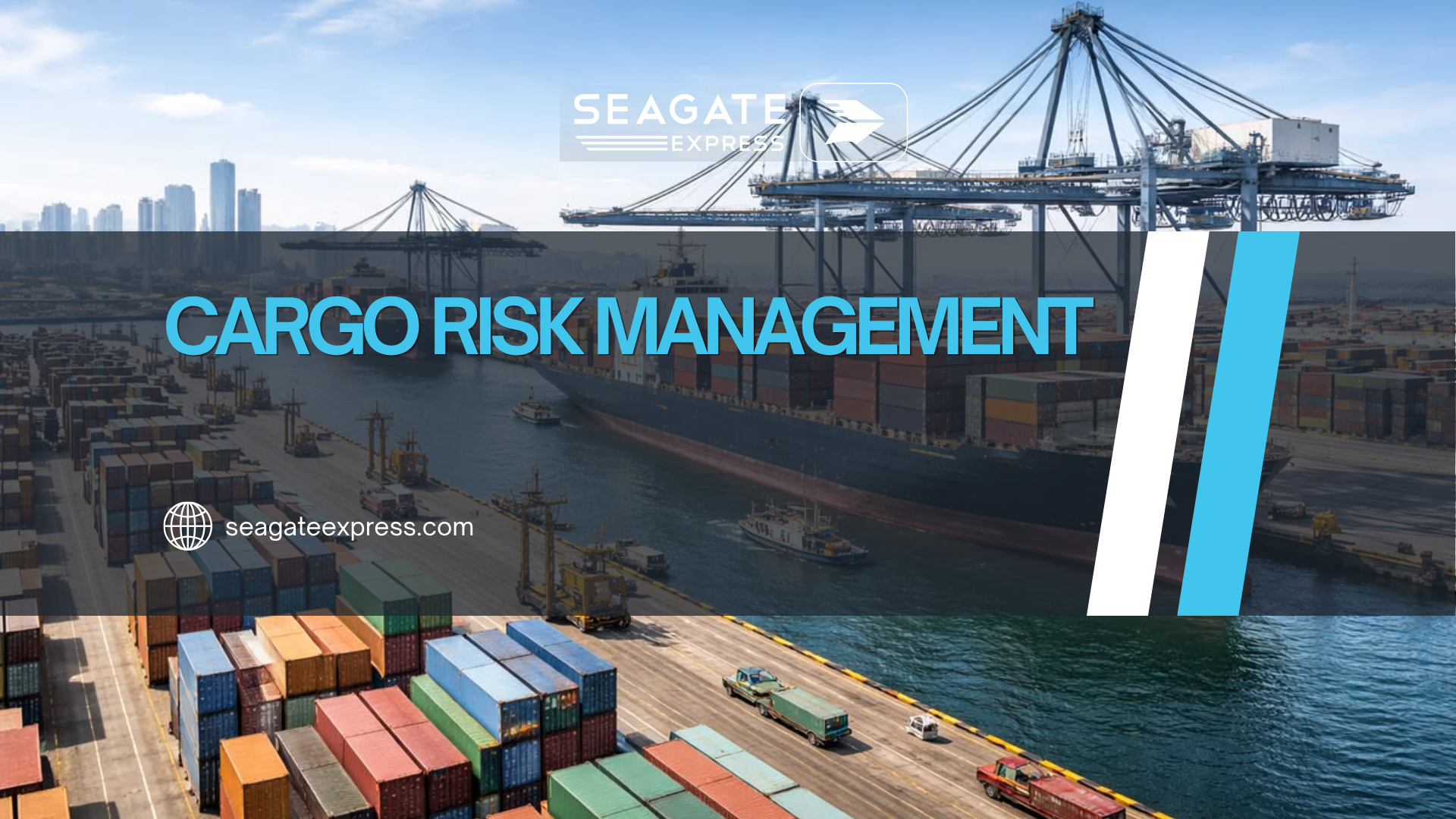
Cargo risk management is the systematic process of identifying, assessing, and mitigating the threats that could cause financial loss, physical damage, or operational disruption to goods in transit. Logistics disruptions cost an estimated $184 billion annually globally (McKinsey Supply Chain Risk Survey 2025), with supply chain cybersecurity remaining critically underprotected. For Egyptian exporters moving fresh produce to Rotterdam or citrus to Dubai, and for importers receiving machinery from Shanghai, the risk landscape in 2026 includes not just traditional physical threats but an expanding set of geopolitical, digital, and climate-related disruptions that require active management rather than passive insurance coverage. This guide explains what cargo risk management involves, identifies the risk types most relevant to Egyptian trade in 2026, provides a four-step framework, and clarifies how cargo insurance fits into but does not replace comprehensive risk management.
What Is Cargo Risk Management?
Cargo risk management is the practice of systematically identifying all the ways a shipment could be lost, damaged, delayed, or compromised, then implementing controls that reduce the likelihood of those events occurring and limit the financial impact when they do. It is distinct from cargo insurance, which compensates for losses after they occur risk management is what you do to prevent or minimize those losses in the first place.
Risk management involves identifying, analyzing, and addressing factors that could interrupt the flow of goods, and it facilitates business adaptability and continuity. A business with strong cargo risk management and appropriate insurance is in a significantly better position than one with insurance alone, because they experience fewer claims, lower premiums over time, fewer supply chain disruptions, and more reliable delivery performance for their customers.
The cargo risk management process follows four sequential stages: Identification (what can go wrong with this specific cargo on this specific route?), Assessment (how likely is it and how severe would the financial impact be?), Mitigation (what actions reduce the likelihood or impact?), and Monitoring (is the risk environment changing, and are the controls working?).
The Main Types of Cargo Risk in 2026
Cargo risk in 2026 is more diverse than at any previous point in modern logistics history, combining traditional physical risks with rapidly growing geopolitical, cyber, and climate-related threats.
Physical Damage Risk
Physical damage to cargo from rough handling at port terminals, vessel movement in heavy seas, moisture penetration, compression damage during loading, and forklift incidents remains the most common type of cargo loss globally. Physical damage risk is highest during port handling phases rather than during the ocean voyage itself the loading and discharging operations where cargo changes hands between multiple parties are statistically the highest-risk moments.
Cargo Theft and Piracy Risk
Cargo theft surged across key domestic and international corridors in 2025, with sophisticated impersonation tactics including fraudulent pickups using fake documentation. For Egyptian trade routes, land-based cargo theft during inland transport remains a practical risk, particularly for high-value electronics, pharmaceuticals, and consumer goods moving between ports and distribution centers.
Delay and Disruption Risk (Red Sea / Suez Canal)
The Red Sea crisis forced the rerouting of major carriers around the Cape of Good Hope, adding 10 to 15 extra transit days and significant emergency surcharges at the height of the disruption. As of mid-2026, the disruption has partially eased but not resolved for Egyptian exporters and importers, delay risk is particularly consequential for perishable cargo with defined shelf lives and for manufacturing supply chains with just-in-time inventory requirements.
Temperature and Spoilage Risk
Temperature exceedances during cargo transit from reefer equipment failure, inadequate pre-cooling, power interruptions at port, or incorrect setpoints result in cargo that arrives technically intact but commercially unsaleable. This risk category is highly relevant to Egypt’s position as a major exporter of fresh produce and an importer of pharmaceuticals and chilled food products.
Cyber Risk The Fastest-Growing Category in 2026
“There is a new type of logistics-related risk taking over cyber risks, online incidents, cyber-attacks, essentially all possible situations where a business can be scammed with fake documents or transactions or fictitious operations. 2026 will unfortunately see more of these affecting businesses.” Christian Satriadi, Head of Cargo Risk Management, Maersk.
A cyberattack on an airline technology provider in September 2025 triggered system failures across major European airports, forcing a switch to manual processes and causing significant delays to both passenger and cargo handling. A single cyber event can disrupt manufacturing schedules, halt deliveries, force manual workarounds, and undermine planning, procurement, and customer service simultaneously. For Egyptian logistics operations, cyber risk materializes specifically in fake documentation submitted through digital platforms, fraudulent freight bookings, and impersonation attacks on Nafeza and CargoX workflows.
Documentation and Compliance Risk
Contract gaps on surcharges many cargo owner agreements with carriers or 3PLs do not automatically pass through war-risk charges, canal tolls, or detour surcharges. Documentation risk in Egypt includes incorrect HS code classification (triggering customs holds and duty overpayment), missing Nafeza ACID numbers (causing port holds and demurrage), and incomplete GOEIC certificates for regulated goods (resulting in cargo detention).

Request a Freight Consultation
Egypt-Specific Cargo Risks What Every Exporter and Importer Must Know
Four risk categories are particularly significant for Egypt-connected logistics in 2026.
Red Sea Security Risk and Suez Canal Disruption
Egypt’s Suez Canal position is simultaneously its greatest logistical asset and its most significant route-level vulnerability. When Red Sea security incidents force carrier rerouting, Egypt-connected trade lanes face extended transit times, higher surcharges, and capacity shortfalls. Conditions in 2025-2026 can flip from tightness to overcapacity within a single quarter freight rate exposure shifts fast, but many corporate budgets still model annual averages.
Practical mitigation: maintain safety stock buffers of at least 2 to 3 weeks of additional transit time, use index-linked freight contracts, and confirm with your freight provider which routing they are currently using before every booking. For current sea cargo context, see our sea cargo Egypt guide.
Port Congestion During Peak Season
Egypt’s Mediterranean ports particularly Alexandria experience significant congestion during the October to January peak agricultural export season. Reefer containers waiting at a congested terminal without adequate power connections can experience temperature exceedances that make cargo commercially worthless before the vessel even loads. For the specific procedures at Egyptian port terminals during peak season, see our customs clearance procedures in Egyptian ports guide.
Nafeza Documentation Risk
Egypt’s mandatory Nafeza ACID pre-registration creates a specific risk that doesn’t exist on most other international trade corridors: cargo that arrives at Alexandria or Port Said without a correctly registered ACID number is held at port, accumulating demurrage charges throughout. The 48-hour advance registration requirement means the problem cannot be fixed on arrival only prevented before departure. For the full Egyptian import requirements context, see our import to Egypt guide.
Temperature Risk for Egyptian Perishable Exports
Egypt’s fresh produce exports are commercially sensitive to temperature deviations during three high-risk periods: farm-to-packhouse transport before pre-cooling; the handoff between reefer truck and reefer container at port terminal; and shore power interruption while the container waits for vessel loading. For cold chain requirements and how to manage these risk points, see our perishable cargo Egypt guide.
The Cargo Risk Management Framework 4 Steps
Step 1: Risk Identification
Before each shipment, explicitly list the risks that apply to this specific cargo on this specific route. Not all cargo faces all risks a container of steel construction materials has minimal temperature risk but significant handling damage risk; a pallet of pharmaceutical samples has minimal theft risk but critical temperature and compliance risk. Risk identification forces cargo-specific thinking rather than applying a generic checklist.
Step 2: Risk Assessment (Likelihood × Impact Matrix)
For each identified risk, estimate the likelihood of occurrence (low/medium/high) and the financial impact if it occurs. The product of these two factors a Risk Priority Score helps allocate mitigation effort to the risks that matter most. According to McKisey, nearly 80% of supply chain executives have identified the need to improve visibility by investing in digital planning tools, recognizing that a lack of insight into processes leads to unanticipated disruptions.
Step 3: Risk Mitigation
For each prioritized risk, select a mitigation approach from four options: Avoid (don’t ship via the risky route or mode); Reduce (implement controls pre-trip inspection, documentation review, experienced broker); Transfer (purchase insurance to transfer the financial impact to an insurer); or Accept (acknowledge the risk without additional controls, appropriate only for low-priority risks).
Proactive risk management including enhanced monitoring, controlled handoffs, and security-focused routing will help protect your cargo. The companies that adapt early will be better positioned to manage uncertainty, protect cargo, and maintain customer trust.
Step 4: Risk Monitoring and Review
Build routing optionality and inventory buffers: factor in longer detours, like sailing around the Cape of Good Hope, when building supply and operations plans. Risk monitoring requires regular review of whether the risk environment has changed Red Sea conditions, new Egyptian customs regulations, new GOEIC requirements for regulated goods and whether the mitigation controls that were effective last quarter are still appropriate. Given the rapidly changing environment of 2025-2026, quarterly reviews are more appropriate than annual ones.
How Cargo Insurance Fits Into Risk Management
Cargo insurance is one of four risk mitigation strategies specifically, it is the Transfer strategy for risks that cannot be eliminated through operational controls.
What Insurance Covers vs What Risk Management Prevents
Cargo insurance compensates for financial losses after they occur. It does not prevent the damage from happening, does not recover the commercial opportunity cost of a delayed shipment, and does not compensate for losses excluded from the policy (inherent vice, improper packing, delay-related losses).
Risk management prevents losses from occurring through operational controls like pre-trip inspection, correct packaging, experienced customs brokers, port-resident freight providers, and proactive Nafeza documentation. A business with strong risk management files fewer insurance claims which translates directly into lower insurance premiums over time.
ICC (A), (B), (C) Which Level Matches Your Risk Profile
The ICC coverage level selected for cargo insurance should reflect the risk profile identified in Step 2 of the risk management framework. ICC (A) All-Risk coverage is appropriate for high-value goods, temperature-sensitive cargo, and any shipment where the cost of a claim denial would be commercially severe. ICC (C) minimum coverage is only appropriate for robust bulk commodities where the excluded risks are genuinely low-probability. For a detailed breakdown of what each ICC level covers and excludes on Egyptian routes, see our cargo insurance Egypt guide. For the specific marine insurance framework and the CIF minimum insurance trap, see our marine insurance Egypt cargo guide.
The War Risk Gap on Red Sea Routes (2026)
Standard cargo insurance policies typically exclude war and political risk unless a specific War Risk extension is added. With insurance companies continuing to classify the Red Sea as high-risk in 2026, the War Risk extension is a non-optional addition for any cargo insurance policy covering Egyptian sea freight. The extension typically adds $50 to $200 per container to the insurance cost justified by the financial exposure it covers on routes where carrier liability is capped far below cargo value. Seagate’s marine insurance service includes War Risk extension assessment as part of standard policy configuration.
Technology and Tools for Cargo Risk Management in 2026
Real-Time GPS and IoT Temperature Monitoring
GPS-enabled tracking devices in reefer containers and temperature data loggers that transmit readings continuously allow shippers and freight providers to detect temperature deviations and unexpected stops in real time enabling intervention before damage becomes irreversible. Leveraging real-time weather forecasting and temperature-compliance analytics helps prevent excursions. For operators moving biologics or diagnostics, this is now a compliance requirement.
Freight Market Intelligence (Xeneta, Drewry WCI)
Adopt index-linked and surcharge-aware contracts: link part of your shipping spend to reliable freight indices like Drewry’s World Container Index, and include clear rules for extra charges such as war risk, canal fees, and bunker fuel. Freight market intelligence tools provide real-time benchmarking that allows Egyptian shippers to identify when they’re being charged above-market rates for surcharges reducing cost and financial risk of unexpected invoice inflation.
Cyber Risk Protection for Digital Documentation
To mitigate cyber risks in 2026, companies should implement digital verification systems that validate the authenticity of trade documents, use multi-factor authentication for all freight booking and documentation platforms, and train operations staff to recognize impersonation tactics. For Egyptian logistics operations specifically, this includes verified access controls on Nafeza and CargoX accounts and document verification checkpoints before cargo is released to a carrier.
Digital Twins for Port and Route Simulation
Singapore’s Maritime and Port Authority launched a real-time maritime digital twin in 2025 to simulate vessel flows and energy consumption. By 2026, digital twins primarily mitigate risks around throughput volatility and launch slippage. For Egyptian freight planners, port digital twin insights from Alexandria and Port Said will increasingly allow real-time congestion forecasting that enables shipments to be routed away from peak congestion windows before they occur.
Request a Freight Consultation
Risk Management by Cargo Type Egypt-Specific Applications
Fresh Produce and Perishable Cargo
Risk management for Egyptian fresh produce exports centers on three controls: pre-trip inspection (PTI) of every reefer container before stuffing; shore power confirmation at the terminal before vessel loading; and phytosanitary documentation pre-submission that prevents regulatory holds for time-sensitive cargo. The residual risk that cannot be operationally controlled equipment failure mid-voyage is covered by a perishables-specific insurance clause. For the full logistics framework, see our reefer container shipping Egypt guide.
Project Cargo and Heavy Lift
Risk management for project cargo requires engineering risk assessment route surveys identifying bridge load limits, power line clearances, and road surface conditions before cargo moves combined with mechanical risk controls (equipment inspection, lifting plan validation by certified engineers) and project-specific all-risk insurance. The risk of a $2 million transformer being damaged during the final 5km of road transport to a site is operationally preventable with correct planning and impossible to recover from without appropriate insurance. For the project cargo framework, see our project cargo Egypt guide.
Pharmaceutical and Regulated Goods
Risk management for pharmaceutical cargo imports into Egypt requires GDP-certified storage and transport, continuous temperature monitoring with tamper-evident data loggers, and Ministry of Health import approval pre-confirmation before cargo departs origin. A pharmaceutical shipment that arrives in Egypt without Ministry of Health approval in place cannot be cleared regardless of cold chain integrity the compliance risk is administrative but the commercial consequence is identical to physical loss. For pharmaceutical cold storage requirements in Egypt, see our cold storage logistics Egypt guide.
General Containerized Cargo
For standard general cargo, risk management focuses on documentation accuracy (correct HS code, accurate CIF value declaration, ACID pre-registration), packaging adequacy for sea transport, and cargo insurance selection appropriate to the goods’ value and route risk profile. The four most common risk events for Egyptian general cargo demurrage from documentation delays, customs holds from HS code errors, damage from inadequate packaging, and invoice inflation from undisclosed surcharges are all preventable with standardized pre-shipment checklists. For the container freight service framework, see our container freight Egypt guide.

How to Choose a Logistics Provider That Manages Risk Well in Egypt
The quality of a logistics provider’s risk management practice is one of the most commercially significant but least-discussed criteria in provider selection. Five indicators identify providers who manage cargo risk as an operational discipline.
1. Do they proactively communicate route and carrier risk changes?
A provider who sends updates on Red Sea routing decisions and their impact on your specific bookings is actively managing your risk. A provider who waits for you to ask about a vessel diversion after it’s already happened is reactive.
2. Do they have documented pre-shipment checklists?
A standardized pre-shipment documentation checklist applied to every booking prevents the Nafeza errors, HS code mismatches, and GOEIC certificate gaps that cause port holds. Providers who rely on individual staff memory produce inconsistent outcomes.
3. Can they provide temperature monitoring data from previous reefer shipments?
For perishable cargo, historical temperature monitoring reports demonstrate that they actually monitor cold chain performance rather than simply providing reefer containers and hoping for the best.
4. How do they handle a cargo hold or customs dispute?
Ask specifically what they did in the last three instances where a shipment faced a red channel or customs dispute. A provider who can describe their specific response process has genuine experience. A provider who gives a vague answer about “working closely with customs authorities” does not.
5. Do they facilitate cargo insurance as part of standard service?
A logistics provider who integrates cargo insurance into the freight booking process ensures that the insurance policy matches the actual cargo, route, and risk profile rather than applying a generic policy that may exclude the most relevant risks.
For guidance on evaluating freight forwarders in Egypt, see our freight forwarder in Egypt and logistics companies in Egypt guides. For customs brokerage-specific risk management criteria, see our customs broker Egypt guide. Seagate’s integrated ocean freight, air freight, and custom clearance services incorporate pre-shipment documentation review, carrier routing monitoring, and cargo insurance facilitation as standard elements of every shipment managed.
Request a Freight Consultation
FAQ
What is cargo risk management and why does it matter?
Cargo risk management is the systematic process of identifying, assessing, and mitigating threats to goods in transit from physical damage and theft to documentation failures and cyber fraud. It matters because logistics disruptions cost an estimated $184 billion annually globally, and proactive risk management consistently reduces both the frequency of losses and the financial impact when disruptions do occur.
What are the main types of cargo risk in 2026?
The six main cargo risk categories in 2026 are: physical damage during handling and transit; cargo theft and piracy; delay and disruption from geopolitical events (Red Sea, Suez Canal); temperature and spoilage risk for perishable cargo; cyber risk including document fraud and impersonation attacks; and documentation and compliance risk from incorrect HS codes, missing certificates, and regulatory non-compliance.
What is the difference between cargo risk management and cargo insurance?
Cargo insurance is one risk mitigation strategy the Transfer strategy that shifts financial loss to an insurer after it occurs. Cargo risk management is the broader discipline of preventing losses from occurring through operational controls, documentation accuracy, route selection, and monitoring. Both are necessary risk management reduces claim frequency, which reduces insurance premiums over time.
How does Egypt’s Suez Canal position affect cargo risk management?
Egypt’s Suez Canal position creates route-level concentration risk: when Red Sea security conditions force carrier rerouting, Egypt-connected trade lanes face extended transit times and higher surcharges simultaneously. Mitigation includes maintaining safety stock buffers, using index-linked freight contracts, confirming carrier routing decisions before each booking, and carrying War Risk insurance extension on policies covering Red Sea-routed cargo.
What is cyber risk in cargo management and how is it mitigated?
Cyber risk in logistics includes fraudulent documentation submitted through digital platforms, fake freight bookings impersonating legitimate carriers, and cyberattacks on cargo handling and customs clearance systems. Mitigation requires multi-factor authentication on Nafeza and CargoX accounts, document verification procedures before any payment transfer, and staff training to recognize impersonation tactics.
How often should cargo risk management frameworks be reviewed?
Given the rapidly changing risk environment in 2025-2026 including quarterly freight rate swings, shifting Red Sea security conditions, new Egyptian customs regulations, and growing cyber threat sophistication cargo risk management frameworks should be reviewed quarterly rather than annually.