Egypt's industrial boom demands specialized logistics for heavy machinery, oversized equipment, and time-critical infrastructure components. Project cargo represents the backbone of Egypt's construction, energy, and manufacturing sectors—requiring precision planning, custom transport solutions, and expert customs handling from origin to destination. At Seagate Express, we deliver 98% project cargo success rate with in-house heavy lift specialists, …

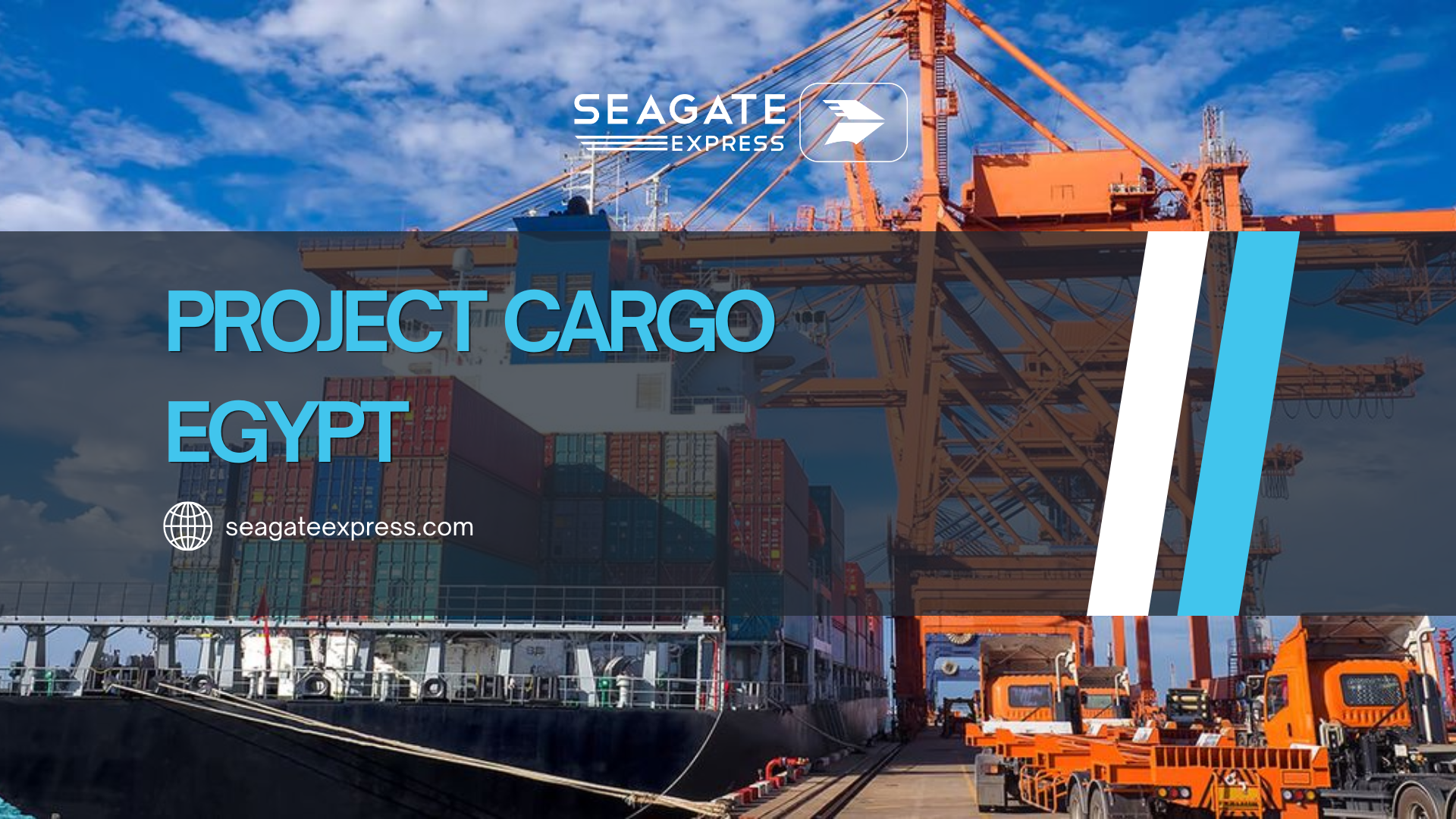
Egypt’s industrial boom demands specialized logistics for heavy machinery, oversized equipment, and time-critical infrastructure components. Project cargo represents the backbone of Egypt’s construction, energy, and manufacturing sectors—requiring precision planning, custom transport solutions, and expert customs handling from origin to destination.
At Seagate Express, we deliver 98% project cargo success rate with in-house heavy lift specialists, modular trailers, and 15+ years of experience handling Egypt’s most complex shipments [about-us].
What Is Project Cargo Shipping?
Project cargo shipping refers to the transportation of heavy, oversized, or high-value equipment for industrial projects—typically requiring custom engineering, specialized transport modes, and coordinated logistics planning. Unlike standard freight, project cargo involves multi-modal transport (ocean + air + overland), custom permits, and milestone-based delivery schedules.
Key characteristics include:
- Weight: 20+ tons per unit (up to 500+ tons for heavy lift)
- Dimensions: Beyond standard container sizes (OOG = Out of Gauge)
- Value: High-value equipment ($100K–$10M+ per shipment)
- Timeline: Project-driven delivery (aligned with construction/installation milestones)
- Complexity: Requires engineering assessments, route surveys, and custom permits
Egypt handles 500+ project cargo shipments annually through Alexandria and Port Said, serving energy, construction, and manufacturing sectors

Request a Freight Consultation
What Is the Difference Between Project Cargo and General Cargo?
| Feature | Project Cargo | General Cargo |
| Purpose | Industrial projects (construction, energy, manufacturing) | Standard commercial shipments (consumer goods, retail) |
| Weight/Size | 20–500+ tons; oversized (OOG) | 0.5–25 tons; standard container sizes |
| Transport Mode | Multi-modal (ocean + air + overland) | Single-mode (container ship or truck) |
| Planning Time | 2–6 months (route surveys, permits, engineering) | 1–7 days (booking + shipment) |
| Customs | Special permits, temporary import, tax exemptions | Standard customs clearance |
| Insurance | Custom project insurance ($1M–$50M coverage) | Standard marine insurance |
| Cost | $50K–$10M+ per shipment | $500–$50K per shipment |
Project cargo is project-driven (aligned with construction timelines), while general cargo is demand-driven (regular commercial shipments).
Project Cargo vs Heavy Lift?
Heavy lift is a subset of project cargo focused on extremely heavy single units (100–500+ tons):
| Aspect | Heavy Lift | Project Cargo |
| Weight Range | 100–500+ tons per unit | 20–500+ tons (multiple units) |
| Equipment | Heavy lift vessels, cranes (500+ ton capacity) | Modular trailers, low-bed trailers, breakbulk |
| Examples | Power plant turbines, ship segments | Construction machinery, wind turbine components |
| Planning | 3–6 months (structural assessments) | 2–6 months (multi-modal coordination) |
Heavy lift = Single ultra-heavy unit (e.g., turbine)
Project cargo = Multiple heavy/oversized units for one project (e.g., entire factory equipment)
Request a Freight Consultation
Project Cargo vs Out of Gauge (OOG) Cargo?
Out of Gauge (OOG) refers to cargo that exceeds standard container dimensions:
| Aspect | OOG Cargo | Project Cargo |
| Definition | Width/height/length exceeds container limits | Heavy + oversized + high-value for industrial projects |
| Weight | Any weight (even light but oversized) | 20–500+ tons |
| Examples | Construction cranes, vehicle frames | Power plant equipment, wind turbines, machinery |
| Classification | Dimensional constraint | Weight + dimension + value + project purpose |
OOG cargo is a dimensional classification, while project cargo includes weight + purpose + complexity.
Which Egyptian Industries Use Project Cargo Logistics?
Egypt’s industrial transformation drives massive project cargo demand across these key sectors:
| Industry | Project Cargo Types | Annual Volume (Egypt) | Key Ports |
| Energy & Power | Turbines, generators, solar panels, wind turbine components | 150+ shipments/year | Alexandria, Damietta |
| Construction | Cranes, excavators, concrete plants, steel structures | 200+ shipments/year | Port Said, Alexandria |
| Oil & Gas | Pipelines, refineries equipment, compressors | 80+ shipments/year | Suez, Ain Sokhna |
| Manufacturing | Factory machinery, assembly lines, robotics | 100+ shipments/year | Port Said, Alexandria |
| Infrastructure | Bridge segments, tunnel equipment, railway systems | 70+ shipments/year | Alexandria, Damietta |
Seagate Express has delivered 1M+ tons of project cargo to Egypt’s energy and construction sectors, including 500-ton turbines for New Administrative Capital power plants

Request a Freight Consultation
What Transport Modes Are Used for Project Cargo in Egypt?
Project cargo requires multi-modal transport to navigate Egypt’s complex logistics network:
Ocean Freight (Breakbulk & Heavy Lift Vessels)
Breakbulk shipping handles individual heavy items (20–200 tons) without containers:
- Vessels: General cargo ships with onboard cranes (50–500 ton capacity)
- Loading: Deck cargo or holds (no containerization)
- Best for: Machinery, steel structures, industrial equipment
- Egypt ports: Alexandria, Port Said, Damietta handle 80% of breakbulk
Heavy lift vessels transport ultra-heavy units (100–500+ tons):
- Capacity: 500–2,000+ ton cranes
- Examples: Power plant turbines, ship segments
- Timeline: 3–6 weeks (booking + transit)
Air Freight for Time-Critical Components
Air freight is used for urgent, high-value project components:
- Weight limit: 70 tons per shipment (max aircraft capacity)
- Best for: Electronics, control systems, spare parts
- Advantage: 24–48 hours delivery (vs. 3–6 weeks ocean)
- Cost: 5–10x higher than ocean freight
- Airports: Cairo International, Alexandria Airport
Pro tip: Use air vs sea freight comparison for time-sensitive components vs. bulk equipment [air-vs-sea].
Overland Freight (Modular Trailers, Low-Bed Trailers)
Overland freight Egypt is critical for port-to-site delivery:
| Trailer Type | Weight Capacity | Best For | Egypt Routes |
| Modular Trailers | 100–500 tons | Ultra-heavy machinery | Cairo–Alexandria, Suez Road |
| Low-Bed Trailers | 50–200 tons | Construction equipment | All major highways |
| Flatbed Trailers | 20–100 tons | Steel structures, containers | Urban deliveries |
Seagate Express operates 30+ modular trailers and 50+ low-bed trucks across Egypt, with 24/7 permits for oversized cargo [overland-freight].
What Are the Main Challenges of Project Cargo in Egypt?
| Challenge | Impact | Solution |
| Customs Permits | 2–6 weeks delay for special clearance | Pre-approval via Egyptian Customs Authority |
| Road Permits | OOG cargo requires Ministry of Transport permits | Route surveys + weight assessments |
| Port Congestion | Alexandria/Port Said face 3–7 day delays | Use Damietta/Ain Sokhna for heavy cargo |
| Weight Restrictions | Some bridges have 40-ton limits | Modular trailers + route planning |
| ** insurance Coverage** | Standard policies don’t cover heavy lift | Custom project insurance ($1M–$50M) |
| Equipment Availability | Heavy lift cranes limited in Egypt | Pre-book 3–6 months ahead |
85% of project cargo delays in Egypt are customs-related—use a dedicated customs clearance agent for smooth processing [customs-agent].
Request a Freight Consultation
What Documents Are Required for Project Cargo Clearance in Egypt?
Project cargo requires specialized documentation beyond standard customs forms:
| Document | Purpose | Required For |
| Commercial Invoice | Value declaration | All shipments |
| Bill of Lading | Ownership transfer | Ocean freight |
| Packing List | Itemized cargo details | All shipments |
| Certificate of Origin | Country verification | All imports |
| Special Import Permit | Customs approval for heavy/OOG | >20 tons or OOG |
| Road Permit | Ministry of Transport approval | OOG overland transport |
| Weight Certificate | Load verification | >50 tons |
| Insurance Certificate | Coverage proof | All heavy cargo |
| Technical Specifications | Equipment details | Machinery, turbines |
For customs clearance documents, download our free checklist: [customs-documents].
How to Choose a Project Cargo Provider in Egypt
Select a project cargo provider based on these critical factors:
| Criterion | Minimum Requirement | Seagate Express |
| Experience | 5+ years in project cargo | 15+ years [about-us] |
| Equipment | Modular trailers, heavy lift cranes | 30+ modular trailers, 500-ton cranes |
| Success Rate | 90%+ clearance success | 98% [about-us] |
| Permits | In-house customs brokerage | Licensed Egyptian Customs Authority broker |
| Insurance | Custom project coverage ($1M+) | $50M coverage [marine-insurance] |
| Global Network | Partners in 20+ countries | 50+ global partners [about-us] |

FAQs
What is the difference between breakbulk and project cargo?
Breakbulk is a transport method (individual heavy items without containers), while project cargo is a shipment purpose (industrial project equipment). Breakbulk can be used for project cargo, but project cargo also includes heavy lift, OOG, and multi-modal transport.
Can project cargo be shipped by air from Egypt?
Yes, but only for urgent, high-value components under 70 tons. Air freight is 5–10x more expensive than ocean but delivers in 24–48 hours. Best for electronics, control systems, or spare parts—not bulk machinery. Use air vs sea freight comparison for decision-making [air-vs-sea].
What equipment is needed to move project cargo on Egyptian roads?
Modular trailers (100–500 tons), low-bed trailers (50–200 tons), and flatbed trailers (20–100 tons). For OOG cargo, you need Ministry of Transport permits + route surveys. Seagate Express operates 30+ modular trailers across Egypt [overland-services].
How long does project cargo clearance take at Egyptian ports?
Standard clearance: 3–7 days (with pre-approved permits). Without permits: 2–6 weeks delay. Use a licensed customs clearance agent for fastest processing [customs-agent]. Alexandria and Port Said face 3–7 day congestion; Damietta is faster for heavy cargo.
Do project cargo shipments need special insurance?
Yes. Standard marine insurance doesn’t cover heavy lift or OOG cargo. Project cargo requires custom insurance ($1M–$50M coverage) with heavy lift endorsements. Get marine insurance coverage before booking [marine-insurance].
Request a Freight Consultation
What is the role of a project cargo forwarder?
A project cargo forwarder coordinates multi-modal transport (ocean + air + overland), secures customs permits, arranges specialized equipment, and manages milestone delivery. They handle engineering assessments, route surveys, and insurance—unlike standard freight forwarders.
Ready to ship project cargo? Seagate Express delivers 98% success rate with 15+ years of experience, 30+ modular trailers, and in-house customs brokerage.
Get a quote for your heavy lift shipment today [contact].